
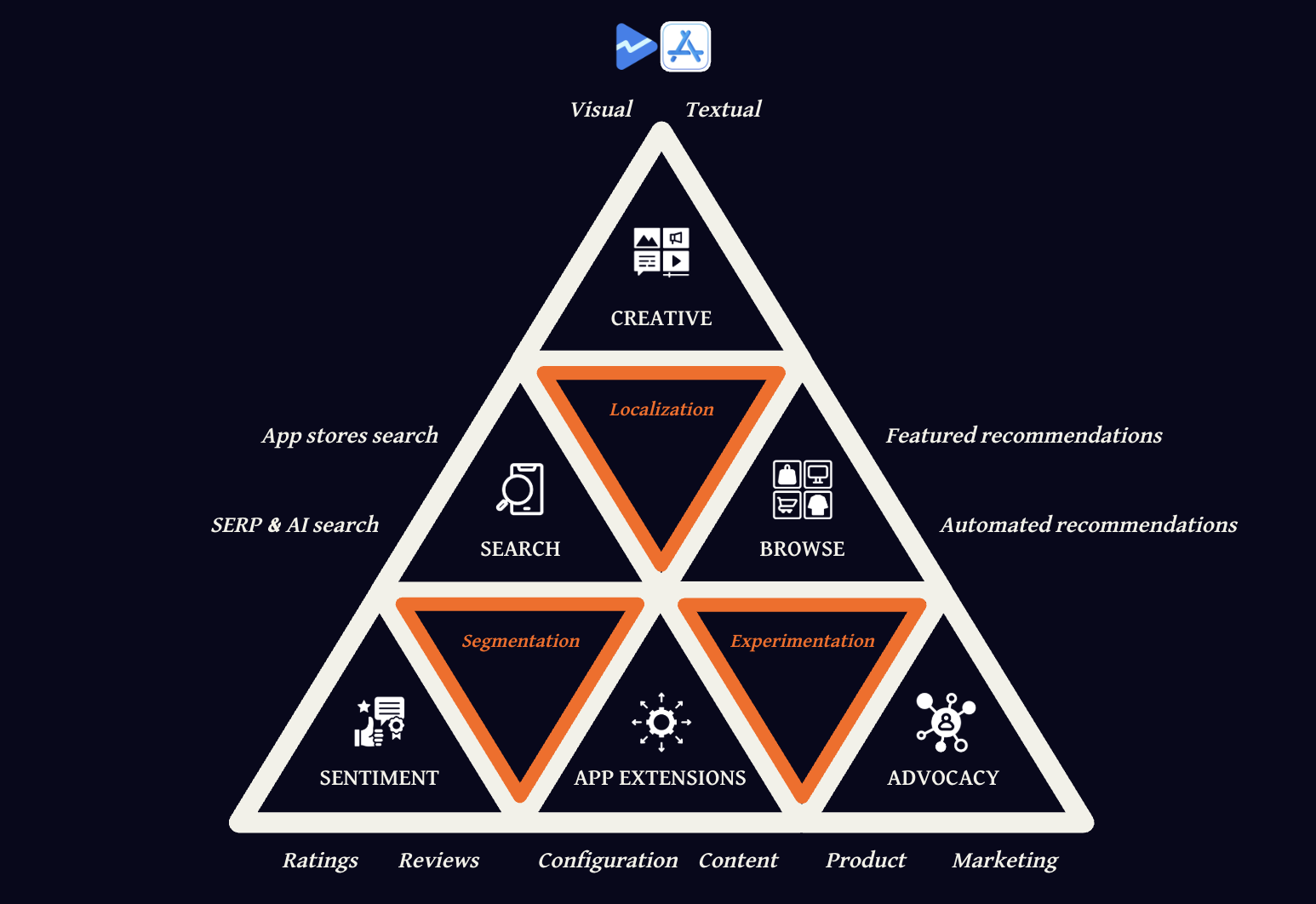
The App Store Optimization (ASO) landscape has evolved far beyond simple keyword stuffing. In 2026, results come from a multi-dimensional strategy where Product-Led Growth (PLG), performance marketing, data science, and more, work in sync.
This framework, Appkitekt's own ASO blueprint, reflects this relationship. It breaks down the core pillars required to dominate the Apple App Store and Google Play Store. No matter how many factors you think you're dealing with, they will, in principle, end up being connected with those pillars. This makes the framework a convenient cheat sheet and reminder for any situation.
1. The Marketing Spearhead
At the spearhead of the framework are the three primary drivers of store presence and conversion rate optimization (CRO):
Creative
This is your "digital storefront." It encompasses everything the user sees before they decide to click "Get" or "Install."
Visual Storytelling: High-impact app icons, panoramic screenshots, and app preview videos must communicate your value proposition in a few seconds. The point of these assets is to stop the scroll, grab the audience's attention, and make them feel like the app could be what they're looking for.
Textual Persuasion: Your Title, Subtitle, Short Description, and other metadata assets must generally balance keyword density with a compelling marketing message that drives action. Provide enough context, and the audience will go from feeling intrigued to knowing they'll get value from the app.
Search
Search remains the highest-intent channel for User Acquisition (UA). ASO, being part of performance marketing, is no different.
App Store Search: Go where your audience is by targeting the keywords they use to look for the apps they want, and by trying to win the top positions. While no longer the heart and soul of ASO, keyword optimization remains a vital building block of an effective strategy by paving the way for your app to reach its audience.
SERP & AI Search: Modern ASO now involves optimizing for Search Engine Results Pages and AI-driven discovery tools that recommend apps based on conversational context rather than just exact-match strings. More and more people are relying on Gemini and ChatGPT to get app recommendations, making AI an essential ASO element. Google also shows app results in web search, making it an inherent part of ASO, too.
Browse
This represents "passive" discovery, where the store's algorithm and editors curate excellent apps to recommend to users. It's the closest thing to becoming ubiquitous, surrounding your audience everywhere they venture across the app stores — because once your app is good enough to be featured, it will continue the streak over and over.
Featured Recommendations: Securing spots in the "Today" tab or "Editor's Choice" through high-quality UI/UX and Apple/Google relationship management. Of course, performance plays a crucial role, too. That's both marketing and product performance — meaning the best way to convince the app stores is to first convince the users to love the app.
Automated Recommendations: Appearing in "Similar Apps" or "You May Also Like" sections, as well as the general and category Top Charts. This is driven by Category Relevance and how well the algorithm understands your app's "neighborhood." Most think these factors are unimportant. All panic when smaller competitors suddenly steal their users simply by looking more interesting next to them. A small but mighty tool.
2. The Technical Foundation
Without a solid base, your acquisition efforts are pouring water into a leaky bucket.
Sentiment (Ratings & Reviews)
This is your "Social Proof." Star ratings are both a ranking factor and a conversion driver. Both the quality of rating (4.8 stars average, etc.) and quantity (500 vs. 500,000 ratings) can make or break your app's relationships with both the algorithms and the audience.
Not only Ratings, but actively managing Reviews and responding to user feedback also signals to both users and algorithms that the app is well-maintained and high-quality. Did you know: Reviews on Google Play are indexed for keywords? Never underestimate them.
App Extensions (Configuration & Content)
Modern ASO involves using every tool the stores provide to stay relevant and captivating. Many elements can help, if you configure them right:
- In-App Events (IAEs) & Promotional Content (PC)
- Promoted In-App Purchases (IAPs)
- Tag Selections
- Custom Store Listings & Product Pages
- And more!
Advocacy (Product & Marketing)
ASO success depends a lot more on non-ASO factors than what the ASO team can directly influence.
Product factors: App features, contents and designs (UX/UI) influence user retention and engagement. Both are app store ranking factors. Product monetization tactics directly influence revenue metrics, several of which are also ranking factors. Technical app health aspects like crash, freeze, size, and so on, are all ranking factors, yet all fall under product, not ASO. Divided, you'll fall. United, you'll stand.
Marketing factors: A series of ranking factors comes from marketing performance, too. From download velocity to brand-driven (trust-based) CVR, marketing has many ways to help (or destroy) ASO. All the more reason to work as a team.
3. The Strategic Core
These orange tactical "bridges" ensure your ASO operations are fueled with strategic planning and goal-oriented decision-making instead of pointless actions.
Localization
True growth happens when you move across borders and beyond literal translation. This involves Localization (and Culturalization) — adapting your creative themes, color palettes, and even featured functionality to match local search trends and cultural nuances in Tier 1 and emerging markets to boost international app growth. Think global, act local.
Segmentation
Beyond obvious tools like Custom Product Pages and Store Listings, segmentation helps you better define which user groups to reach and engage with. If you know who is relevant to your app and why, you'll know what to show and tell in the app stores to capture them. You'll get better ideas in terms of keyword grouping, copywriting tones, and design personas.
Experimentation
Growth is a game of inches. Using Product Page Optimization (PPO) on iOS and Store Listing Experiments (SLE) on Android, you can run rigorous A/B tests on your assets. This scientific method ensures you only deploy changes that have a proven positive impact on your conversion floor. More importantly, it helps you validate ideas — good and bad — and generate learnings you can use to turn visits into profits.
Where Should You Start?
Depending on your role in the mobile app ecosystem, your entry point into this framework will differ. More importantly, this framework is not exclusive to the ASO team. For example:
- For Growth Marketers: Start with Search & Segmentation. Your priority is identifying high-intent Keyword Rankings, aligning your Apple Search Ads (ASA) with organic efforts, and scaling UA efficiency through Custom Product Pages.
- For Product Managers: Focus on Sentiment & Extensions. You should monitor NPS (Net Promoter Score), improve App Stability/Vitals, and utilize In-App Events to drive Day-30 Retention and re-engagement.
- For Creative Producers: Dive into Creative & Experimentation. Your goal is to run continuous A/B tests on visuals and video assets to maximize the CVR and lower the cost-per-install of the ads.
- For Developers: Look at App Extensions & Configuration. Make sure nothing goes missing, and everything is utilized. You want to test them all.
The bottom line: ASO is no longer a siloed task. It is a cross-functional discipline that requires total alignment between design, engineering, and marketing to move the needle for scalable, profitable growth.